First of all, understand that “meditation” is a catchall term for a
lot of different mental activities, many of which have nothing to do
with sitting cross-legged on the floor and saying om.
“There are thousands of different types of meditation,” says Dr.
Andrew Newberg, a neuroscientist at Thomas Jefferson University Hospital
and author of Words Can Change Your Brain. But while
meditative practices come in all shapes and styles, Newberg says nearly
all of them have at least one thing in common: They involve focusing
your attention, a habit that’s been marginalized by our
smartphone-tethered lifestyle of digital distraction.
“That focusing could be on a word or object or physical motion,”
Newberg explains. “But regardless, the type of focusing involved in
meditation activates the brain’s frontal lobe, which is involved in
concentration, planning, speech and other executive functions like
problem solving.” Studies have shown meditation can bolster all of these
mental tasks. But the greatest benefits may spring from the interplay
between your brain’s focus centers and its limbic system—a set of
structures that manage your emotions and regulate the release of stress
and relaxation hormones. MORE: The Mindful Revolution
“Studies suggests your body’s arousal system is calmed and the flow
of stress-related hormones is reduced [by meditation],” Newberg
explains. “There’s also a softening effect when it comes to emotional
responses.” Just as weightlifting allows your muscles to lift a heavier
load, working out your brain with meditation seems to fortify its
ability to carry life’s emotional cargo. That stress-dampening effect
has tied meditation to improved mood and lower rates of heart disease,
insomnia and depression.
Newberg says there’s also some evidence that meditation quiets the
area of your brain that manages your sense of self and your relationship
to others. That may sound like a bad thing, but this quieting may help
you feel more connected to others and less isolated within yourself, he
says.
“Basically, meditation helps your brain get out of its own way,” adds Dr. Judson Brewer, a Yale School of Medicine psychiatrist.
Once you’re convinced meditation is worth a try, figuring out the
right type for you is important, because the benefits tend to
materialize only if you enjoy your practice enough to stick with it,
Brewer says. Luckily, you have a lot of options—from Transcendental
Meditation to Tai Chi. Even yoga counts, because it focuses your mind
and blocks out distraction. MORE: How Tai Chi Helps Fight Depression
Mindfulness is one style of meditation that’s exploding in
popularity, largely because it can be done anywhere and anytime, Brewer
says. “It’s mostly about being aware of your thoughts and not running
after them in your mind,” he explains. Awareness is a wedge that, with
practice, you can place between your thoughts and unhealthy emotional
reactions, he says. MORE: Can Yoga Ease Major Psychiatric Disorders?
That kind of vague, semi-abstract language can make meditation seem
thorny and inaccessible, but it’s easier than you think. If you want a
simple taste of meditation, Brewer suggests focusing your mind on your
breath or a nearby object, refocusing it when it strays. “Your mind
wanders, and you bring it back,” Newberg says. “That’s a mental
push-up.”
Do enough mental push-ups, and you may be amazed at how strong your mind muscle can get.
While previous studies have found
that aerobic exercise and meditation can impact mental health, a study
published last month in Translational Psychiatrycombines the two.
“Scientists have known for a while that both of these activities alone can help with depression,” says Tracey Shors, a professor of exercise science at Rutgers and co-author of the study. “But
this study suggests that when done together, there is a striking
improvement in depressive symptoms along with increases in synchronized
brain activity.”
The study included 52 participants—22 diagnosed with depression. For
eight weeks, volunteers meditated for 30 minutes and completed 30
minutes of aerobic exercise twice a week. Researchers tested their
ability to concentrate and mood before and after the eight weeks of
training.
The 22 participants with depression reported a 40% reduction in their
symptoms. The other individuals in the study without a diagnosis of
depression also reported a decrease in ruminative thoughts, anxiety, and
an overall improvement in motivation.
Brandon Alderman, lead author of the study, hypothesizes that
meditation and running together might strengthen neural mechanisms in
the brain.
From writer Gretchen Reynolds in The New York Times:
“We know from animal studies that effortful
learning, such as is involved in learning how to meditate, encourages
new neurons to mature” in the hippocampus, [Alderman] said.
So while the exercise most likely increased the number of new brain
cells in each volunteer’s hippocampus, Dr. Alderman said, the meditation
may have helped to keep more of those neurons alive and functioning
than if people had not meditated.
Since this is a small study, it remains to be seen if these improvements are sustained.
How to Be Your Best Possible Self For RelationshipsResearch suggests that building optimism about the future increases your happiness and paves the way for stronger and more fulfilling connections. By Mindful Staff | March 26, 2016 iko/Dollar Photo Club iko/Dollar Photo Club Do you know how to create the kinds of relationships that feel good? Research suggests thatbuilding optimism about the future can motivate us to work toward our desired future and thus make it more likely to become a reality. This exercise asks you to imagine your relationships going as well as they possibly could, then write about this best possible future. By doing so, research suggests that you’ll not only increase your happiness but pave the way for stronger and more fulfilling connections. TIME REQUIRED 15 minutes per day for two weeks. HOW TO DO IT Take a moment to imagine your life in the future, and focus specifically on your relationships. What is the best possible romantic, social, and family life you can imagine? This could involve, for example, having a supportive partner, good relationships with your children and/or parents, and a close group of friends. Think about what your best possible relationships would look like for you. For the next 15 minutes, write continuously about what you imagined about these best possible future relationships. Use the instructions below to help guide you through this process. It may be easy for this exercise to lead you to examine how your current relationships may not match the relationships you’d like to have in this best possible future. You may be tempted to think about ways in which achieving the relationships you want has been difficult for you in the past, or about financial/time/social barriers to developing these relationships. For the purpose of this exercise, however, we encourage you to focus on the future—imagine a brighter future in which you are your best self and your circumstances change just enough to make these desired social connections happen. This exercise is most useful when it is very specific—if you think about having a better relationship with your parents, for instance, describe exactly what would be different in the ways you relate to each other; if you think about having a partner or new friend, describe how they interact with you, what you might do together, and so on. The more specific you are, the more engaged you will be in the exercise and the more you’ll get out of it. Be as creative and imaginative as you want, and don’t worry about grammar or spelling. WHY IT WORKS By thinking about your best possible future relationships, you can learn about yourself and what you want in your relationships. This way of thinking can help you restructure your priorities in life in order to reach these goals. Additionally, it can help you increase your sense of control over your relationships by highlighting what you need to do to achieve your goals. For more on the research behind why this works, visit the Greater Good In Action. This article was adapted from Greater Good In Action, a site launched by UC Berkeley’s Greater Good Science Center, in collaboration with HopeLab. Synthesizing hundreds of scientific studies, Greater Good in Action collects the best research-based methods for a happier, more meaningful life—and puts them at your fingertips in a format that’s easy to navigate and digest.
Bouts of depression range from the
mild and infrequent to the severe and chronic. For serious depression,
you should seek qualified help. But for any level of depression, it
helps to know that underlying the darkness is happiness—and our brain is
equipped with the means to uncover it.
Illustrations by Mindful, with files from Andromina/Dollar Photo Club and Tets/Dollar Photo Club
When I was living in
San Francisco during my twenties, I built a successful career in sales.
At night, I lived fast and partied recklessly, abusing drugs and alcohol
with a like-minded group of drifting souls. Eventually my despair and
shame grew so deep that I isolated myself from my family and friends and
lost myself in my addictive behaviors.
Occasionally, in some of the seedier bars I frequented, I
would come across a mess of a man who was so strung out that he repulsed
me. I remember saying to my friends, “God help me if I ever turn out
like him.” I thought, since I was managing to succeed at work, I was in
control of my self-abusive behavior. But one night, after many hours of
partying, I saw the truth of who I had become. When I found myself
slumped beside that man and his equally dazed companion in the back of a
broken-down limousine, I saw my own reflection in his wasted face and
realized I was throwing away my life. I jumped out of the limousine,
determined to transform myself.
As for so many others, it was mindfulness practice that
turned things around for me. My family urged me to spend a month away at
a retreat center. During that time, I questioned everything I did and
all that I believed. Answers began to come to me: I wanted to stop
abusing my body. I wanted to find the purpose and meaning of my life. I
wanted to be happy.
I wanted to heal myself, and eventually, I realized, I
wanted to help heal others who faced some of the same challenges that
had nearly broken me. I trained as a clinical psychologist and began
running Mindfulness-Based Stress Reduction (MBSR) and Mindfulness-Based
Cognitive Therapy (MBCT) programs focusing on helping people relate to
stress better and not relapse into depression. Now having worked with my
own depressive tendencies and with hundreds of clients, I know that
uncovering happiness is not about simply being drunk on life but is
found in a profound and enduring experience of learning how to lean into
loving ourselves and others in good times and in bad. It’s a happiness
based on a sense of common humanity, connectedness, and purpose. While I
still get hooked by self-judgments and negative thoughts, I have
learned to be grateful for the good moments and a bit more graceful
during the difficult ones, knowing that all things in life come and go.
I’ve come to believe that I’m benefitting from natural antidepressants
that are present in the human brain.
When you hear the word antidepressant, you probably think
of a pill: a medication used to treat your illness. Medications are one
kind of antidepressant. But they’re not the only kind.
Science is now showing that we also have natural
antidepressants within our brains: mindsets (thoughts and behaviors)
that build us up instead of tear us down and allow us to help ourselves
improve our own moods.
These natural antidepressants can be gathered into five
main categories: mindfulness (the one I focus on in this piece),
self-compassion, purpose, play, and mastery. By developing these natural
antidepressants, you can strengthen your brain’s ability to act as its
own antidepressant that can be as powerful as—or even more powerful
than—the antidepressant medications.
I recognize the value of antidepressant medications, and I
believe they can play an important role in the treatment of clinical
depression. I’ve seen pharmaceuticals be lifesavers for some depressed
patients, giving them the help they need to engage in necessary
psychological treatment.
However, I also believe these drugs are heavily
overprescribed and overused. For many patients, antidepressants cause
more harm than good. They can create a cascade of mental health problems
that go far beyond the depression they were prescribed to treat. Too
many people get caught in the trap of jumping from one drug to the next
or taking multiple prescriptions in order to offset serious side effects
caused by individual drugs.
Whether you are on antidepressants and they’re working for
you, you’re on them and want to get off of them, or you are not on
antidepressants at all, cultivating natural antidepressants can support
your ability to get better at overcoming the depressive cycles. Whatever
your experience with depression has been—whether you just have the
blues, you have chronic low-grade unhappiness, or you’ve experienced one
or more major depressive episodes—you have the power to change the way
you feel. By getting help in understanding how depression works and
making the choice to nurture your natural antidepressants, you can
become stronger and more resilient.
Science shows that we have natural antidepressants within
our brains and, with some work, they can be as powerful as—or even more
powerful than—medication.
The Depression Loop
I’ve found during my work with depression that it’s
helpful to envision it as a kind of circular process: an automatic loop
rather than a linear set of events. Clients find it useful to think of
it as a cycle, a spiral, or even a traffic circle. If you live someplace
where there are lots of traffic circles or if you have ever driven on
one, you know how confusing and maddening they can be.
You’re driving on a straight road, minding your own
business, maybe humming along with a song on the radio, and suddenly a
traffic circle looms ahead. It just kind of appears on the street ahead
of you. Your mind instantly starts anticipating entering the circle, how
the cars may stream in, and how you’re going to exit. A feeling of fear
or anxiety arises; your hands start to sweat and grip the steering
wheel. As you enter, you search for a sign for a way out, and halfway
through the circle you realize that you have to switch lanes to jockey
for a position so you’re ready for your exit. Meanwhile, you drive by
other entrance points that each admit streams of new cars into the
circle. You see your exit, but you realize that you either have to speed
up or slow down. If you miss your exit—which is so easy to do—you have
no choice but to loop around again hoping that next time you’ll make
your way out.
Falling into the depression loop is a lot like entering a
traffic circle. You’re living your life, feeling fine, minding your own
business, and all of a sudden you find depression looming. Maybe it’s
just a feeling you wake up with, a moment when you suddenly fall prey to
a shaming inner critic that says something like “there’s something
wrong with me/ you,” or a response to hearing some negative news. Once
you’re in it, you try valiantly to get out. But it’s so easy to get
stuck.
Just as various roads lead you into a traffic circle, the
depression loop has four entrance points: thoughts, feelings,
sensations, and behaviors. Any one of these can lead you into the
depression loop. Once you’re caught inside the loop, your mind goes
around and around, struggling to get out. Streams of thoughts enter the
loop as your brain struggles to figure out “What’s wrong with me?” As
one of my students says, “The bloodhound is sniffing around for the
villain (and much analysis is required).” The brain anxiously defaults
to reaching back into the past, referencing and rehashing negative
events to try to figure it out. Simultaneously, the brain jumps into the
future, planning, rehearsing, and anticipating some upcoming hopeless
catastrophe. As all this happens, the brain pours stress into an already
stressful situation.
You may see an exit, but as you try to leave the loop, you
find yourself blocked by more depressive thoughts, feelings,
sensations, and behaviors. Before you know it, the traffic gets even
heavier with the addition of streams of fear and anxiety when you begin
to perceive that you’re becoming trapped in the self-perpetuating
depression loop. You’re desperate for escape, but, sideswiped by fear
and negativity, you become so overwhelmed that you just keep going
around and around and around. Soon a sense of learned helplessness sets
in: you can no longer even see the exit, so you stop trying to break
free and begin to believe you may never escape.
This was a common occurrence for one of my patients,
30-year-old Sandy, who had experienced bouts of depression her whole
life. Typically she would feel fine for a while, but then at times,
seemingly out of nowhere, she would become depressed. Sandy would lose
interest in activities she usually enjoyed and have trouble finding the
motivation she needed for everyday tasks. Feelings such as unworthiness
and guilt would begin to flood her mind, and in response, she tended to
isolate herself from her family and friends and make choices that fueled
her depression rather than pull her out of it.
Sandy experienced depression as a persistently reinforcing
loop that dragged her down. Negative thoughts would trigger troubling
feelings (or vice versa) that in short time would turn into an
ever-present depressed mood state. This would make it tough for Sandy to
get out of bed in the morning. Doing the activities she usually enjoyed
felt nearly impossible, and instead of partaking in life, Sandy would
often end up sitting in her apartment feeling terrible about herself,
eating too much, drinking too much, and sinking deeper and deeper into a
morass of gloom.
Sandy didn’t know this, but each time she experienced a
bout of depression and got lost in the depression loop, her brain
actually changed. When we practice anything in life over and over again,
it starts to become automatic; in psychology, we call that a
conditioned habitual reaction, and in neuroscience, it’s called experience-dependent neuroplasticity.
Right now 80 billion to 100 billion nerve cells, or neurons, are
interacting with what some have said are one trillion connections,
called synapses, in an unimaginably fast and dynamic network. When we do
something over and over—whether it’s something we’re trying to learn,
such as improving our tennis stroke; or something we’d rather not learn,
like an anxiety response to dogs after being bitten by one — neurons in
our brains fire together. As we repeat these actions, they eventually
wire together, making the process an unconscious habit.
One day Sandy came to see me looking particularly
distressed, and she told me that she’d received an email that a client
of hers was angry with her work. In exploring it together, we realized
that this kind of cue triggered worries about losing that client,
increasing her anxiety, and making her heart race and her breathing
become shallow. Her mind spiraled with negative hopeless thoughts about
the future of her business, and she began to avoid doing her work. Sandy
knew she was getting depressed, and this spiraled into more fear. Her
response prevented her from dealing with the client’s email in a
logical, objective way.
Sandy was ready to start breaking this cycle when she
finally recognized her depressive loop for what it really was: a deeply
conditioned habit (or trauma reaction). In fact, just understanding the
concept of the depression loop was enough for Sandy to start effecting a
change in her relationship to depression. She was able to see it in
action in her daily life and name it. The moment she saw it occurring,
she was able to stand apart from it in a space of awareness that was
separate from the loop itself and gain perspective. She no longer felt
she was the loop—rather, she was the aware person viewing the loop. In
this space, she found a sense of freedom and a “choice point,” a moment
in time when she was aware enough to choose a healthier response.
Illustration by Mindful, with files from Andre Cerdas/The Noun Project and iStock.com/Hudiemm
The first step in uncovering happiness and experiencing
freedom from the depression loop, then, is learning how to objectively
see this loop in action instead of getting lost in it. The moment we
notice the depression loop in action is a moment we’ve stepped outside
of it, into a space of perspective and choice.
From there, we have more work to do. The brain habits we
have can be deep-seated. The helplessness we’ve learned can stick with
us. The beauty is, though, that science is now showing us that through
intentional repetition and action, we can change our brains for the
better.
And one of the most helpful ways to do that is to
counteract our tendency to want to believe we are a problem to be fixed.
Instead we can be present for what comes up in our lives and make
choices in the small space that opens up between a stimulus and our
response. That’s where mindfulness comes in.
Once we notice the depression loop in action we’ve
already stepped outside of it, into a space of perspective and choice.
From there, we have more work to do.
Being Versus Doing
We are hardwired to solve problems. When a problem arises,
we want “to do” something about it. That’s how we’ve evolved and have
made the wheel, our first tools, the chairs we sit on, the houses we
live in, and even how to read and understand these words. Problem
solving is an essential part of life. But contrary to the brain’s
belief, life itself is not a problem to be solved; it’s a constantly
evolving experience to be lived.
Here’s how problem solving gets us trapped deeper in the depressive loop:
The moment we experience an uncomfortable emotion, the
brain sees it as a threat because of its potential to lead to
depression. We’re supposed to feel well, and when we don’t, there is a
discrepancy between where we are and where we “should be.” This mind
thinks, “There is something wrong with me.” It perceives a defect, a
deficiency, an unworthiness. The brain sees this as something “to fix”
and uses self-judgment to tell us that something is wrong with us or
maybe conjures up doomsday scenarios to prepare us for possible
catastrophes. Then, because of these potential threats, the brain
remains on high alert to see if any more signs of relapse arise. The
voice inside the mind inquires anxiously, “Is it gone yet? How about
now?” This only adds pressure to an already stressful state of being.
The more the brain focuses on this gap, the more it highlights it in our
minds and strengthens the belief that “something is wrong with me.”
This only sinks us deeper into the depression loop, which
spurs the brain “to do” something more, continuing to add more fuel to
the fire.
But when we’re doing this, where are we? We’re not in the
present—and that’s exactly where we need to be to take charge of our
brains and see the choices to make a change by using mindfulness.
Mindfulness is about balancing the brain’s implicit agenda
by training it “to be” with what’s there instead of needing “to do”
something about it. In using mindfulness to learn how to be with our
feelings, we send a message internally that we’re worthy enough to pay
attention to. This closes the gap between where we are and where we
think we should be (which makes us feel unworthy), and that disrupts the
depression loop.
Right now you can choose to stop what you’re “doing” for
30 seconds and practice this state of “being.” Just take a breath and
acknowledge how you are. Is your mind racing, or is it calm? Is your
body tense anywhere, or is it relaxed? Are you feeling anxious, bored,
restless, excited, tired, or any number of other emotions?
Breathe in, breathe out. You have arrived.
Here’s an opportunity to stop reading and begin working on
developing mindfulness. It’s a short exercise that you can immediately
start using to help move away from the conditioned loop of depression
and into a space of hope and possibility.
Learning how to be is a one-minute practice that can be
done anywhere and anytime as a barometer of how you’re doing. As best
you can, treat this as an experiment in your life. Try it out at first
in the moments when you aren’t sinking and see what you notice. Like any
habit, the more you integrate this into your day, the stronger it
becomes in your short-term memory, and the more likely it is to be
retrieved during the difficult moments.
Note: First, see if you can set aside any judgments of
whether this practice will or will not work for you. Engage this just
with the goal of being aware of your experience.
Breathe: Take a few deep breaths. Notice your breath as
you breathe in and out. You might even want to say the word “in” as you
inhale and “out” as you exhale. This is meant to pop you out of
autopilot and steady your mind.
Expand: This is the process of expanding your attention
throughout the body and just feeling your body as it is. You can start
by noticing the positioning of your body. Then you can move to being
curious about how your body is feeling. Imagine that this is the very
first time you’ve ever felt your body. You may feel warmth or coolness,
achiness, itchiness, tension, tightness, heaviness, lightness, or a
whole host of sensations. Or perhaps you notice no sensation at all in
other areas. When you’re here, also be aware of how emotions are being
expressed in the body. Calm may be experienced as looseness in the back
or face. You might also notice painful feelings. Maybe this comes up as
tension in the chest or shoulders. If there is physical pain, see what
happens if you get curious about the sensation of it and allow it to be
as it is. If it gets too intense, use this as a choice point to become
aware of what matters in the moment or what you need. Maybe you need to
get up, move around, and roll your shoulders. Awareness is the
springboard to getting in touch with what matters.
That’s it! It may sound too simple to be impactful, but,
again, set aside your judgments and let your experience be your teacher.
Just practice being, breathing, and expanding into the
body in mini moments throughout the day to train your brain to be in
that space of awareness and choice that will lead you to a more balanced
and mindful life.
To help you remember, you might consider posting signs in
your environment that say “Just Be.” Just as signs on the road remind us
to slow down or watch for children crossing, signs around the house or
office can remind us to be how we want to BE. Or maybe put a note in
your digital calendar to pop up a couple times per day as a reminder. Or
the best way to remember may be to share the idea with a friend to
remind each other from time to time.
The benefits are enormous—it just takes intention and practice.
Like any habit, the more you integrate mindfulness into
your day, the stronger it becomes in your short-term memory, and the
more likely it is to be retrieved in difficult moments.
Natural Antidepressants
Mindfulness
A flexible and unbiased state of mind where you are open
and curious about what is present, have perspective, and are aware of
choices.
Self-compassion
You understand your own suffering and use mindfulness,
kindness, and openness to hold it nonjudgmentally and consider it part
of the human condition.
Purpose
You are actively engaged in living alongside your values,
are inclined toward compassion for others, and possess an understanding
of how your existence contributes value to the world.
Play
A flexible state of mind where you are engaged in some
freely chosen and potentially purposeless activity that you find
interesting, enjoyable, and satisfying.
Mastery
You feel a sense of personal control and confidence and
are engaged in learning to get better and better at something that
matters.
Five Major Mind Traps
These voices keep us stuck in the depression loop. One of
the keys to cultivating an antidepressant brain is realizing you are not
these thoughts or the stories they tell. Here are some ways to avoid
falling into these traps.
Doubt
Whenever you hear advice about how to work with challenges
you have, you might notice the voice of doubt: “This might work for
some people, but it’s probably not going to work for me.” The motive of
this voice is to keep us safe from failure or disappointment, but
ultimately it keeps us away from new experiences that can be supportive.
Emptiness
Longing to be elsewhere, our minds settle on the belief
that the current moment is never enough, we’re not enough, or we can’t
do enough, it’s all so empty. The problem with this kind of thinking:
When the awaited event does occur, happiness may not come with it. This
motive of trying to fix the current moment leaves you in a perpetual
cycle of dissatisfaction.
By focusing on the idea that you’re not where you “should
be,” your brain is constantly reinforcing the message that something is
wrong with you, which then highlights a gap of deficiency that only
grows wider as it tries harder. The root problem is not what you don’t
have, but the fact that you really don’t feel whole or complete.
Irritation
Someone might be walking down the hallway at work humming
his favorite tune, and thoughts come up: “Does he think everyone wants
to hear him? Uh, what is he so happy about anyway?”
Meanwhile, who’s suffering? We’re the ones in pain, but
our brains think if we project our irritation onto another person, we’ll
find relief from the pain. If these voices continue to come up in our
relationships and aren’t discussed, the feelings turn into resentment
that inevitably eats away at the relationship like a cancer. But voices
of irritation can alert us that something isn’t right and, with
awareness, we can use this information to be constructive.
Sluggishness
Have you ever had the idea to do something that’s good for
you—hang out with friends, exercise, meditate—but you hear this voice:
“I want to do it, but I’m too tired. I’ll do it tomorrow.”
If we’re actually tired—maybe we haven’t slept enough or
had an exceptionally taxing day—we need to listen to our bodies and
rest. At other times, these sluggish voices are just another sign we’re
avoiding being with ourselves because we fear that it will be
uncomfortable. If we can recognize it, we can face it and when we can
face it, we can work with it and break free.
Restlessness
These days our brains are being trained to be noisier,
busier, and more distracted. You’re sitting alone waiting for a drink.
Your eye catches your phone: “I wonder if I received any new messages.
Nope, not one since a minute ago. What about Facebook, anything there?
Some new updates, not that interesting. Twitter? Ah, that’s an
interesting tweet. I wonder when the drink is going to come?”
When there’s a space empty of doing, restless voices rise
up. We feel compelled to fill the spaces, but we don’t realize that in
these empty spaces, we have a choice between doing and being; it’s where
possibility and opportunity emerge, and where there is a chance to make
changes for the better.
Take a Self-Compassion Inventory
Here are a few questions to help you gauge the strength of
your self-compassion muscle. (Note: if you find it’s low, don’t worry,
just like a muscle, it can be strengthened.)
1. Where does the inner critic pop up? At work? When you walk past the mirror? In relationships? In relation to parenting?
2. What are the repercussions of being so hard on yourself? Does it add to the depression loop?
3. When something difficult arises in life and you fall
under stress, where do you rank on the priority list of people to take
care of? Do you apply caring to your suffering or try to avoid it?
4. When things are tough, do you tend to compare yourself
with others, thinking that they have it together? Or do you have a
balanced perspective, knowing that all humans struggle?
5. What would the days, weeks, and months ahead be like if
your stress and inner struggles were met with more understanding and
caring?
Three Simple Mindfulness Practices You Can Use Every Day
Every minute of our lives serves up
something new and gives us an opportunity to learn. But when it comes
to the usual ways of learning—reading, writing, and listening to
others—we often lose the freshness of direct experience and instead just
shovel information into our brains. Mirabai Bush suggests how to learn
more deeply and with more enjoyment.
We’re all learning all
the time. Parents learn to care for children, students learn physics,
soldiers learn survival skills, and all of us learn the latest app or
how kale will make us healthy. But much of what we call learning isn’t
particularly useful: I just “learned” on Facebook that someone I hardly
know baked cupcakes today. Riveting!
Mindful learning, on the other hand, cultivates insightful
knowing rather than just a brain overloaded with information.
Mindfulness creates space to let new information in and to allow us to
see how it relates to what we already know. Recent neurological research
at Harvard shows how this happens: mindfulness may actually increase
the size of your brain.
When I learned mindfulness practice in 1970, I felt for
the first time in my life that I knew something to be absolutely true. I
was breathing in and breathing out—that was really happening. I
actually saw thoughts and judgments arise, like “I’m not nearly as good
as these other meditators. Look, their backs are straighter than mine.
They’re wearing the perfect white clothes. I’m in a funky embroidered
shirt.”
Where did those thoughts come from? They arose in my mind,
and then, if I wasn’t obsessing about them, they would float or fall
away. The important thing was how I saw thoughts arise and disappear. I
was beginning to see how my mind worked, and even if I didn’t like what
it was doing, I felt more whole, more integrated, more confident. Not
really knowing my breath or my mind seemed like not knowing
what my face looked like. How could I have missed them? Of course we all
know we are breathing and thinking, but it was radically different to
experience them directly instead of intellectually. It wasn’t just an idea that I breathe—it was me breathing. I had learned something important in a whole new way.
That led me to look at the other ways we learn, to see
whether they could benefit from mindfulness. I wanted to understand
ideas, images, skills, and people in an intimate way, with the clarity
and confidence I was experiencing as I came to know my own mind and
body. I wanted to create space in my mind instead of that crowded
carnival of ideas and information and judgments. I wanted to be open to
learning something new, to see things with new perspectives and
understanding. Mindfulness, with its focus, openness, inquisitiveness,
and humility, seemed like the perfect approach.
Here are some of the practices I discovered.
Mindful Reading
Reading these days, whether on a screen or on paper, is
more often a race to finish the text than a search for meaning. Woody
Allen captured it: “I took a speedreading course and read War and Peace in 20 minutes. It involves Russia.”
Mindful reading is radically different. It slows down the
reader and the reading—that alone changes the experience. It is a
process of quiet reflection that requires mindful attentiveness, letting
go of distracting thoughts and opinions to be fully in the moment with
the text. It moves the reader into a calm awareness, allowing for a more
profound experience and understanding. Here are some methods for
mindful reading:
The Wrap-Around
Before reading, sit quietly for some minutes. Bring your
attention to your breath, letting go of thoughts and sensations,
returning to the breath again and again. Then read. Notice if you read
with more focus and appreciation. When you finish reading, sit again for
some minutes, again bringing your mind to your breath. At the end of
your practice, notice what you have learned from the reading.
Savoring a Resonant Phrase
Sit quietly and then read a short piece, perhaps a page
long. What phrase stands out for you? Return to that phrase and repeat
it to yourself, perhaps several times. Just sit with it. What does it
evoke? Notice what images or ideas or memories arise. Do any of the
words have meaning beyond the obvious? What meaning does this phrase
give to the rest of what you’re reading? Hold the phrase in your mind,
giving it time to suggest more to you. Now reread the full piece. How is
it different? Has your relationship to it changed?
One from Many
Reading doesn’t have to be private. You can do this
practice with as few as two people, but the more the merrier. Each
person has a copy of the same poem or piece of prose. All sit quietly
and focus on the breath. One person reads the entire text aloud. All sit
in silence. After a while, one person reads the first line aloud. Out
of the silence after that line, the next person who feels moved to read
speaks the second line. And so on, until it is finished. Ask yourselves
whether hearing the same words in different voices affects the meaning.
Mindful reading is radically different from racing to
cram information in. It slows down the reader and the reading—that alone
changes the experience.
Mindful Writing
Writing benefits from the capacities that mindfulness
cultivates: seeing and hearing things just as they are, bearing witness
to life; being in the moment, even when remembering the past or
imagining the future; not judging others and oneself while still
exercising discriminating wisdom; holding multiple perspectives; being
open to the new; and practicing kindness, compassion, and patience.
Mindful awareness helps us see, in Gerard Manley Hopkins words, “all
things…original, spare, strange.”
At the same time, it acknowledges our interconnection. All
of us, when we write, are giving something, and we need a reader who
will accept our gift. We each write out of our own loneliness to express
ourselves to another human being.
What follows are some ways to bring mindfulness to your writing.
Journal Writing
Writing in a journal is one of the oldest methods of
self-exploration and expression. Although they’re not written for
publication and often don’t last longer than their authors, we have
extraordinary examples of journals in the work of Virginia Woolf, Thomas
Merton, May Sarton, and Anne Frank, among others. As these illustrate, a
journal can help one cultivate the ability to live in the present, to
become deeply aware and appreciative of life. There are many journal
practices. Here are a few:
Once a Day : Write something new
every day. Add a drawing or a photograph to it. Journals, like
mindfulness, help us appreciate the simple fact that every moment in our
lives brings something new and different. We only need to notice it.
Be Your Own Researcher : Write each day what you are learning from mindfulness practice—or anything else.
Social Media Practice : Write
about your experience of using social media. What sensations do you
notice in your body before and after you communicate? What sensations do
you notice when you receive a comment or tweet?
Being Here Now : Stop in your
tracks once a day: take account of the sky, the ground, and yourself,
then write what you noticed. Or, while walking down a street or country
road, stop, turn in a circle, and write what you remember. Or, sitting
with your notebook, write six sentences, beginning each with “Here and
now….”
Mindful Emailing
Emailing allows us to get work done quickly with people
around the globe. But without the emotional signs and social cues of
face-toface or phone interaction, it’s more possible to be
misunderstood—particularly if there’s trouble at hand. Also, mindless
emailing overstuffs everyone’s inboxes.
Try this with 5 or 10 emails during the week. Or all of them.
COMPOSE an email.
STOP and take one long deep breath. Pay attention
to the breath. You can count to five on the inhale and again on the
exhale if you like.
THINK of the person to whom the email is going and
how you want them to receive your message. Could they misunderstand your
words and become angry or offended, or think you’re being more positive
than you intend?
LOOK at the draft email again.
CHANGE it if appropriate.
SEND
Free Writing
Free writing is a method of mindful inner inquiry; you
never know what you will learn until you start writing. Then you
discover truths that you didn’t know existed.
Begin writing and write continuously for a set period of
time, say 10 to 15 minutes. If it helps, use a prompt, like “Right now I
am feeling….” Or, “I have always been afraid to ….” Keep the pen
moving, with no pauses to correct spelling, grammar, or punctuation.
Write down whatever is arising in your mind, without judgment. Keep
writing. When the time is up, stop and read.
When you write, it’s possible not to judge others or
yourself and still exercise discriminating wisdom, to hold multiple
perspectives, and to be open to the new.
Mindful Listening
When we are listening mindfully, we are fully present with
what we’re hearing without trying to control it or judge it. We let go
of our inner clamoring and our usual assumptions, and we listen with
respect to precisely what is being said. We listen to our own minds and
hearts and, as the Quakers say, to the “still, small voice within.” We
listen to sounds, to music, to lectures, to conversations, and, in a
sense, to the written word.
For all of these kinds of listening to be effective, so we
understand and remember what is being heard, we need a mind that is
open, fresh, alert, attentive, calm, and receptive. We often do not have
a clear concept of listening as an active process that we can control,
but, in fact, mindful listening can be cultivated through practice.
Wake Up Listening
Early morning is especially good for listening. Try this:
As you wake up, instead of turning on the TV, your iPhone, or your
computer, be still and just listen. In a rural setting, the sounds may
be birds and animals waking up. In a city, sounds of outside action
begin: garbage collection, building construction, traffic. On campus,
the sounds of opening doors, feet walking in the hallways, other
students talking. Listen for the soft sounds: a cat purring, leaves
rustling. Rest your full attention on one sound until it fades away,
then let another come to you. As thoughts come into your mind, gently
let them go and return to the sound. Then get out of bed and enjoy the
sound of the water on your skin in the shower.
In the Groove
Put on some music, maybe classical or slow tempo. Notice
the sound and vibration of the notes, the sensations in your body as you
listen, and the feelings the music brings up in you. When you notice
thoughts arising, gently bring your attention back to the music.
Breathe.
In the Shelter of Each Other
Thoreau said, “The greatest compliment that was ever paid
me was when one asked me what I thought and attended to my answer.”
Mindful listening helps us be fully present for another person. It is
the gift of our attention. It moves us closer to each other. It allows
the speaker to feel less vulnerable and more inclined to open up to the
listener. Not listening creates separation and fragmentation, which is
always painful.
To listen mindfully to another person, stop doing anything
else, breathe naturally, and simply listen, without an agenda, to what
is being said. If thoughts about other things arise, gently let them go
and return to the speaker’s words. As responses arise in your mind, wait
until you’ve heard all that has to be said before replying. Try not to
let your story overcome the speaker’s. Be curious; don’t assume that you
know. Listen for feelings as well as the words.
And you will want to be listened to also. But when you’re
speaking, if the person you’re talking to doesn’t appear to be mindfully
listening, be patient. As Winnie the Pooh once said, “It may simply be
that he has a small piece of fluff in his ear.”
These roadblocks keep us stuck in
the depression loop: caught up in negative thoughts, feelings, and
behaviors as the brain anxiously rehashes past events and simultaneously
rehearses a hopeless, catastrophic future. Here are some ways to avoid
falling into these traps.
These voices keep us
stuck in the depression loop. One of the keys to cultivating an
antidepressant brain is realizing you are not these thoughts or the
stories they tell. Here are some ways to avoid falling into these traps.
Doubt
Whenever you hear advice about how to work with challenges
you have, you might notice the voice of doubt: “This might work for
some people, but it’s probably not going to work for me.” The motive of
this voice is to keep us safe from failure or disappointment, but
ultimately it keeps us away from new experiences that can be supportive.
Emptiness
Longing to be elsewhere, our minds settle on the belief
that the current moment is never enough, we’re not enough, or we can’t
do enough, it’s all so empty. The problem with this kind of thinking:
When the awaited event does occur, happiness may not come with it. This
motive of trying to fix the current moment leaves you in a perpetual
cycle of dissatisfaction.
By focusing on the idea that you’re not where you “should
be,” your brain is constantly reinforcing the message that something is
wrong with you, which then highlights a gap of deficiency that only
grows wider as it tries harder. The root problem is not what you don’t
have, but the fact that you really don’t feel whole or complete.
Irritation
Someone might be walking down the hallway at work humming
his favorite tune, and thoughts come up: “Does he think everyone wants
to hear him? Uh, what is he so happy about anyway?”
Meanwhile, who’s suffering? We’re the ones in pain, but
our brains think if we project our irritation onto another person, we’ll
find relief from the pain. If these voices continue to come up in our
relationships and aren’t discussed, the feelings turn into resentment
that inevitably eats away at the relationship like a cancer. But voices
of irritation can alert us that something isn’t right and, with
awareness, we can use this information to be constructive.
Sluggishness
Have you ever had the idea to do something that’s good for
you—hang out with friends, exercise, meditate—but you hear this voice:
“I want to do it, but I’m too tired. I’ll do it tomorrow.”
If we’re actually tired—maybe we haven’t slept enough or
had an exceptionally taxing day—we need to listen to our bodies and
rest. At other times, these sluggish voices are just another sign we’re
avoiding being with ourselves because we fear that it will be
uncomfortable. If we can recognize it, we can face it and when we can
face it, we can work with it and break free.
Restlessness
These days our brains are being trained to be noisier,
busier, and more distracted. You’re sitting alone waiting for a drink.
Your eye catches your phone: “I wonder if I received any new messages.
Nope, not one since a minute ago. What about Facebook, anything there?
Some new updates, not that interesting. Twitter? Ah, that’s an
interesting tweet. I wonder when the drink is going to come?”
When there’s a space empty of doing, restless voices rise
up. We feel compelled to fill the spaces, but we don’t realize that in
these empty spaces, we have a choice between doing and being; it’s where
possibility and opportunity emerge, and where there is a chance to make
changes for the better.
We have all suffered hurts and
betrayals. Choosing to forgive is a way to release the distress that
arises again and again from the memory of these incidents—but
forgiveness is often a long and difficult process.
This exercise outlines several steps that are essential to the
process of forgiveness, breaking it down into manageable components.
These steps were created by Robert Enright, Ph.D.,
one of the world’s leading forgiveness researchers. Although the exact
process of forgiveness may look different for different people, most
anyone can still draw upon Dr. Enright’s basic principles. In certain
cases, it might help to consult a trained clinician, especially if you
are working through a traumatic event.
And remember, everyone forgives at his or her own pace. We suggest
that you move through the steps below based on what works for you.
HOW TO DO IT:
1. Make a list of people who have hurt you deeply
enough to warrant the effort to forgive. You can do this by asking
yourself on a 1-to-10 scale, How much pain do I have regarding the way
this person treated me?, with 1 involving the least pain (but still
significant enough to justify the time to forgive) and 10 involving the
most pain. Then, order the people on this list from least painful to
most painful. Start with the person lowest on this hierarchy (least
painful). 2. Consider one offense by the first person on your
list. Ask yourself: How has this person’s offense negatively impacted by
life? Reflect on the psychological and physical harm it may have
caused. Consider how your views of humanity and trust of others may have
changed as a result of this offense. Recognize that what happened was
not okay, and allow yourself to feel any negative emotions that come up. 3. When you’re ready, make a decision to
forgive. Deciding to forgive involves coming to terms with what you will
be doing as you forgive—extending an act of mercy toward the person who
has hurt you. When we offer this mercy, we deliberately try to reduce
resentment (persistent ill will) toward this person and, instead, offer
him or her kindness, respect, generosity, or even love.
It is important to emphasize that forgiveness does not involve
excusing the person’s actions, forgetting what happened, or tossing
justice aside. Justice and forgiveness can be practiced together.
Another important caveat: To forgive is not the same as to reconcile.
Reconciliation is a negotiation strategy in which two or more people
come together again in mutual trust. You may not choose to reconcile
with the person you are forgiving.
These questions are not meant to excuse or condone, but
rather to better understand the other person’s areas of pain, those
areas that make him or her vulnerable and human.
4. Start with cognitive exercises. Ask yourself
these questions about the person who has hurt you: What was life like
for this person while growing up? What wounds did he or she suffer from
others that could have made him or her more likely to hurt you? What
kinds of extra pressures or stresses were in this person’s life at the
time he or she offended you? These questions are not meant to excuse or
condone, but rather to better understand the other person’s areas of
pain, those areas that make him or her vulnerable and human.
Understanding why people commit destructive acts can also help us find
more effective ways of preventing further destructive acts from
occurring in the future. 5. Be aware of any little movement of your heart
through which you begin to feel even slight compassion for the person
who offended you. This person may have been confused, mistaken, and
misguided. He or she may deeply regret his or her actions. As you think
about this person, notice if you start to feel softer emotions toward
him or her. 6. Try to consciously bear the pain that he or she
caused you so that you do not end up throwing that pain back onto the
one who offended you, or even toward unsuspecting others, such as loved
ones who were not the ones who wounded you in the first place. When we
are emotionally wounded, we tend to displace our pain onto others.
Please be aware of this so that you are not perpetuating a legacy of
anger and injuries. 7. Think of a gift of some kind that you can offer
to the person you are trying to forgive. Forgiveness is an act of
mercy—you are extending mercy toward someone who may not have
been merciful toward you. This could be through a smile, a returned
phone call, or a good word about him or her to others. Always consider
your own safety first when extending kindness and goodwill towards this
person. If interacting with this person could put you in danger, find
another way to express your feelings, such as by writing in a journal or
engaging in a practice such as compassion meditation.
As people suffer from the injustices of others, they often realize that they themselves become more sensitive to others’ pain.
8. Finally, try to find meaning and purpose in what
you have experienced. For example, as people suffer from the injustices
of others, they often realize that they themselves become more sensitive
to others’ pain. This, in turn, can give them a sense of purpose toward
helping those who are hurting. It may also motivate them to work toward
preventing future injustices of a similar kind.
Once you complete the forgiveness process with one person on your
list, select the next person in line and move up that list until you are
forgiving the person who hurt you the most.
For more on the research behind why this works, visit the Greater Good In Action.
This article was adapted from Greater Good In Action, a site launched by UC Berkeley’s Greater Good Science Center, in collaboration with HopeLab.
Synthesizing hundreds of scientific studies, Greater Good in Action
collects the best research-based methods for a happier, more meaningful
life—and puts them at your fingertips in a format that’s easy to
navigate and digest.
By Tara Healey and Jonathan Roberts
Our faces are windows into our most intimate feelings. Yet we’re apt
to treat them as strangers, reserving for them our harshest criticism.
We’re surrounded by mirrors that show us our faces. But how often do
we really take the time to look at our faces, as opposed to
concentrating on ways to conceal what we consider to be their less than
agreeable qualities? The onslaught of internal commentary is probably
familiar to us all. “My nose is too big/too small.” “I wish I had more
hair/less hair!” “Why can’t I be more like my sister?” “…my brother?”
“…my daughter?” “…my friend?”
Intuitively we know the face is like a stream, constantly moving and
shifting in response to conditions. We witness this flux in the faces
around us, and their expressions can move us to empathy. And yet when it
comes to our own faces, we throw compassion out the window.
Enter mindfulness, which helps us see how things are with an attitude
of receptivity, balance, and patience. Observing with unshaded eyes how
we respond to ourselves, we lay the groundwork for building a
relationship with ourselves—and others—steeped in trust and acceptance,
as opposed to constant dodging or denial. 1. Sit in front of a mirror, in a well-lit place. Make your face the focal point, and relax it as much as possible. 2. Bring awareness to each part of your face:
forehead, eyes, cheeks, nose, lips, chin, jaw. Now include your hair and
ears. Note what you see objectively, without judgment. They’re not
“wrinkles,” for example, but instead, as the philosopher Emmanuel
Lévinas put it, places where the face has left “a trace of itself.” 3. Pay attention to internal comments of liking or disliking,
as well as places in your face or elsewhere in your body where you
experience tightness, clenching, or discomfort. Notice if your
thoughts spin out—does resistance to the shape of your nostril expand
into recalling a difficult conversation earlier in the day? Notice the
emotions that cling to any of these thoughts or physical sensations. 4. Releasing areas where you are holding tension, watch the topography of your face shift and settle. What do you notice?
Extend to yourself a wish of good will and well-being. It’s like the sentiment captured in these lines from Derek Walcott:
The time will come
when, with elation
you will greet yourself arriving
at your own door,
in your own mirror
and each will smile
at the other’s welcome. 5. Observe your face again. Bring the attention that a grandmother would bring to the face of a beloved grandchild. Tara Healey is program director for mindfulness-based learning at Harvard Pilgrim Health Care, and Jonathan Roberts is an administrator and copywriter there.
For more on mindfulness practice, go to mindful.org/inpractice. To submit questions about techniques, the workplace, or relationships and home life, email inpractice@mindful.
This article also appeared in the October 2014 issue of Mindfulmagazine
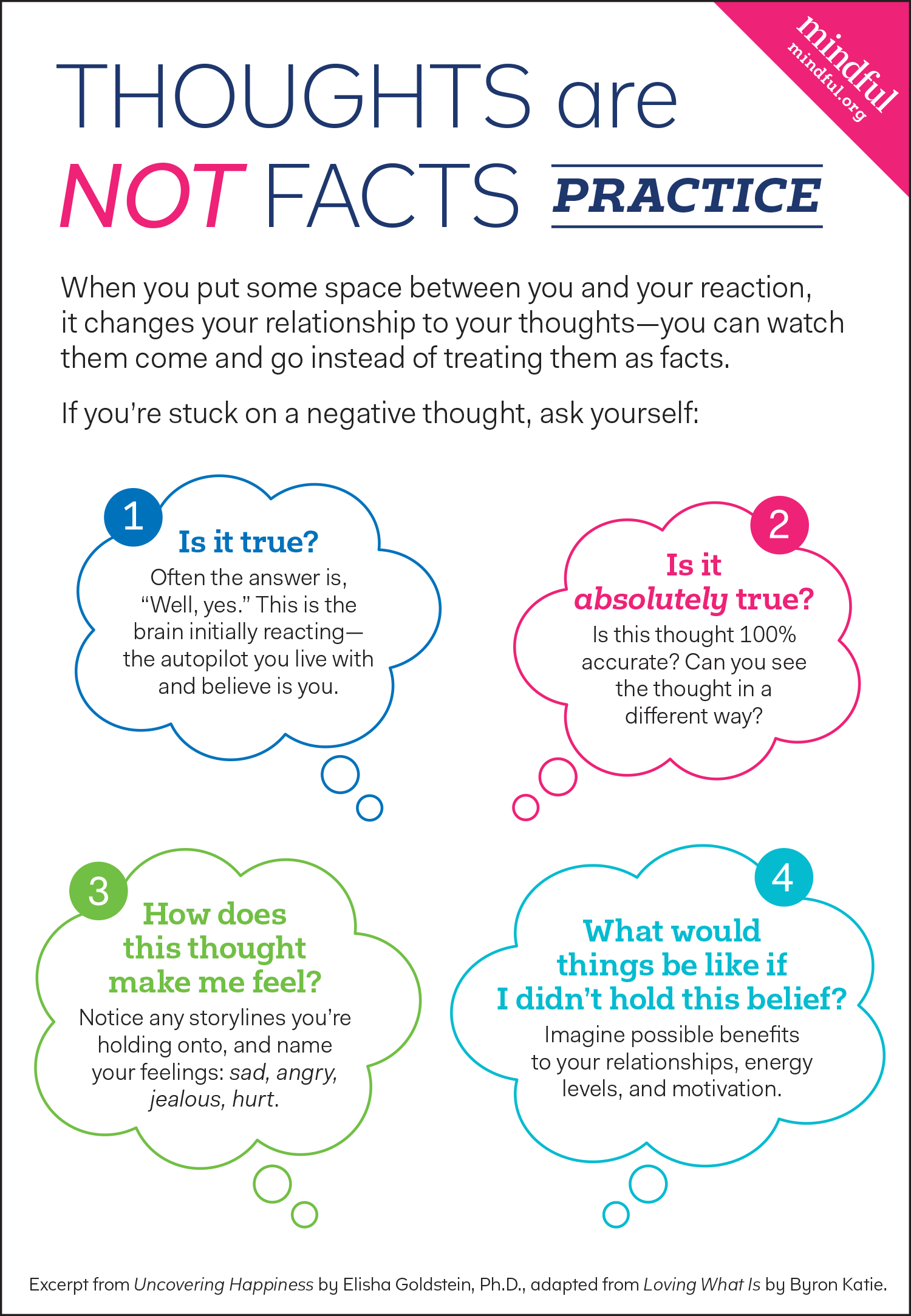
Next time your mind jumps to a
conclusion that inevitably sends in you in a spiral toward depression or
anxiety, check to see where your head was at the time of that
interpretation.
Click the infographic to enlarge it or click here. Above excerpt from Uncovering Happiness by Elisha Goldstein.
So you’re waiting in the hallway with your mind spinning about how
it’s been a pretty crappy day and life just doesn’t seem to be moving in
the direction you’d like it to. Your friend walks by you and although
you raise your hand to wave hi, she looks at you and just walks by.
Take a moment to sense what happened in your mind before reading any further.
Various thoughts may have arisen in connection with uncomfortable emotions:
• “What did I do wrong?”
• “I’m worthless.”
• “I knew it, nobody likes me.”
• “What the hell is wrong with her?”
• “What’s the point, really.”
OK…now let’s say your boss just told you what a fantastic job you’ve
done and how she’s going to give you a 15% raise and an extra week
vacation. This is great news…as your mind is spinning around all the
ways this will enhance your life, your friend walks by and as you raise
your hand to say hi, she just walks by.
Now what comes up in your mind?
Many people might have an alternative viewpoint here.
• “I wonder what’s wrong with her.”
• “I hope she’s ok.”
• “Maybe she didn’t see me.”
Same event, different precipitating event and mood, different interpretation.
The bottom line: Thoughts simply aren’t facts, they are mental events that pop up in the mind and are dependent on our mood. In this case, dependent on the precipitating event that led to the mood of feeling depressed versus excited.
Next time your mind jumps to a conclusion that inevitably sends in you in a spiral toward depression or anxiety,
check to see where your head was at the time of that interpretation.
What just occurred prior? There may be some clues as to why the
interpretation was made that way.
As always, please share your thoughts, stories and questions below.
Your interaction creates a living wisdom for us all to benefit from.
Adapted from Mindfulness & Psychotherapy